
Hip and Groin Pain After Total Knee Replacement Surgery
I couldn’t find peer-reviewed data to support an answer to this question, but as a physical therapist with 20 years of history in the clinic, I can tell you that anterior hip and groin pain after a total knee replacement is not uncommon.
As of writing this article on November 8, 2021 I have two patients in the clinic with anterior hip and groin pain following a total knee replacement.
Anterior Hip and Groin Pain After Total Knee Replacement
A recent YouTube comment asked:
“
Hey Tony, I had my right knee replaced on October 20, 2021. The surgeon used the muscle-sparing technique using robotics.
The problem I’m having is my right groin is killing me and hurts when I try to lift my leg. I previously had my right hip replaced in 2015. The groin has been bothering me for probably the last year or so.
I saw a surgeon in Feb of 2020 and at the time he said I had bone on bone arthritis of my right knee and would need a replacement. I thought once I had my knee replaced, the pain in my groin would go away. My current surgeon saw a current x ray of my right hip and he said everything looked fine.
I was thinking maybe something went wrong with my right artificial hip. Any suggestions as to what I should do next. Chiropractor, PT, family physician?
It’s really slowing my recovery from knee surgery. Thank you for your time. Sandy Antoinette.”

Video Response
Step 1 – Identify the structure causing the pain.
In the clinic, the first thing I would do as the evaluating physical therapist is to determine the structure I believe is causing the pain.
I would try active and passive movements to determine if I thought it was muscle or ligament.
I would vary the position of the hip during movements like hip flexion, extension, abduction, and adduction.
If I was able to eliminate the pain with positional changes I would feel more confident that it is a mechanical problem.
* Note: If the pain didn’t change with positioning I would have to ask myself if it could be a chemical problem.
Step 2 – Create a treatment plan.
After I identify the structure possibly contributing to the symptoms, I would develop a treatment plan to strengthen the tissue, facilitate normal tissue healing, ensure proper range of motion and mobility within the structure and minimize the negative effect in the surrounding tissues.
It can also help to try different assistive devices. If you want to know more about switching from a cane to a walker click here.
Step 3 – Assess progress and track improvement.
The final step is to assess progress and track improvement. If we were able to determine the pain is not causing tissue harm or damage, then we would test painful movements after each session and between sessions to determine improvement.
Often, patients will stop an activity because it hurts, but how something feels during the activity might not be as important as how it feels after the activity.
If something hurts at the time of exercise, but then feels better later that day or the next morning then it is usually a good thing to keep performing those exercises.

Anthony Maritato, PT
Physical Therapist
Anthony Maritato, PT is an Ohio licensed physical therapist and private practice owner.
Mr. Maritato specializes in helping patients who have received a total knee replacement or rotator cuff repair surgery. Ohio license #PT011602
Table of contents
Anterior Hip and Groin Pain After Knee Replacement
Video Response


How To Use A Stationary Bike After A Total Knee Replacement
The upright stationary bike is a very common tool used in the rehabilitation of your total knee replacement. In many cases the upright stationary bike is preferred because it reduces the knee flexion requirements. In this video I show you some tips for using a stationary bike at home and turning a standard upright bike into a recumbent bike.
How to prepare for knee replacement surgery?
There is a lot you can do before your total knee replacement surgery to prepare. Step 1: Improve your cardiovascular fitness – your body will be dedicating much of its time and energy to repairing tissue. The better your heart and lungs are working the better your body can recovery. Step 2: Strengthen the rest of your body. While you are waiting on your knee surgery, you can strengthen the other 87% of your body. Step 3: Get your game face on. There will be plenty of mental and emotional challenges along the path to recovery. The better you prepare yourself to face these challenges the better you will be to overcome them.
Easiest Way To Increase Knee Bend At Home After A Total Knee Replacement Sitting – Real Patient
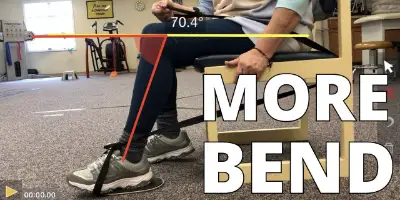
There are an infinite number of ways to bend your knee and all too often I see clients who have been told heel slides need to be completed while laying on your back. That simply isn’t the case. In this video I show you how to perform heel slides seated in a chair and using a strap to assist.