0:00
Good morning guys Tony Maritatto here licensed physical therapist. So one of
0:04
the most common questions we get is related to challenges getting range of
0:09
motion knee flexion knee extension. In this video I'm going to show you one of
0:13
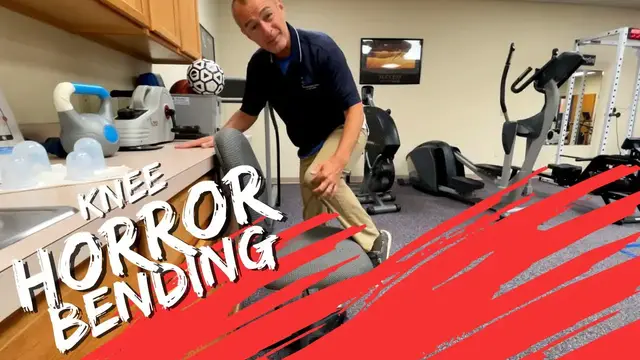
my favorite ways to work on knee flexion at home using something as simple as an
0:18
office chair. So this is a standard office chair I took it away from my desk
0:22
for a minute. What I like about this is it's got reasonable cushion but it's also
0:28
got kind of this this beveled edge that's really comfortable on the shin
0:33
bone so when you think of how your therapist was stretching your knee into
0:37
flexion usually what the therapist is going to do is they're going to grab
0:40
either high on the shin bone to push back or they're gonna grow go down by the
0:45
ankle and what I've found over the years is that pushing down at the ankle
0:49
becomes more threatening to the joint and patients tend to resist that whereas
0:54
pressing from the the high shin bone is a lot less threatening you get less
0:59
leverage so you can't push as hard but the idea is it translates the tibial
1:03
bone posterior which is better for knee flexion and it just allows for a more
1:07
pleasurable experience so using a chair like this I back it up either against a
1:13
kitchen counter or a desk something that's real stable that's not gonna move
1:16
anywhere if this is my surgical leg what I would do is I would come in and
1:21
And there a couple ways to do this So if you can see the angle of knee flexion this is close to 90 degrees It a little less than 90 degrees My knee is going to be somewhere around the middle of the seat And I just going to apply a little bit of pressure Now the pressure can be on the incision as long as your surgeon said it was okay But the pressure is more so at the bottom kind of below the knee joint at the top of the shin bone And so what I doing is I applying some pressure and then I release the pressure
1:54
As I work back and forth into the position, out of the position, I'm translating the tibial bone posterior
2:02
I'm allowing the knee to flex. Now at this angle, you should see that I'm greater than 90 degrees of flexion
2:08
right here vertical line through the femur it's about 90 degrees as i go back i'm getting more
2:16
than 90 degrees as i bring my shin forward so that now there's more pressure down at the ankle
2:23
i get better leverage but i also get more knee flexion so i can really control how much bend i
2:31
get through my knee depending on where i put my leg on the chair you have total control over how
2:37
much pressure, you have total control over what position, how frequently you can do it. I prefer
2:44
this to heel slides. I prefer this to a lot of other ways that somebody would try to mobilize
2:49
their own knee at home. But it's one of those things that you have to experiment with. You have
2:54
to talk to your physical therapist about, see if this is the right thing for you. Obviously
2:59
if I'm standing on my right leg and my left leg is my surgical side
3:04
my right hip is going to be working a lot my right leg has to be stable enough to hold myself
3:10
in this position but I've just found over the years that this is one of the best ways for
3:16
patients to work on improving knee flexion multiple episodes throughout the day so guys if you have
3:22
more questions about it let me know if you want to get the link to our Facebook group total knee
3:26
replacement support group for kind people go ahead and check the description of this video
3:30
and I'll catch you on the next recording