0:00
Hey guys, Tony Maritato here, licensed physical therapist
0:03
And in this video, I want to talk about the transition, working on a squatting position
0:09
When we're starting therapy after a total knee replacement, your therapist might ask
0:13
you to do a sit to stand. That's basically a squat, a squatting exercise
0:18
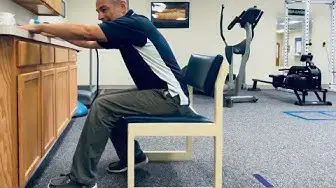
And so functionally, one of the ways that I like patients in my clinic to work on sit
0:23
to stands at home is to initially have a kitchen sink in front of them because the kitchen
0:28
sink is really stable. has kind of a nice grip that you can hold on to and as I sit into a chair this allows me to kind
0:37
of maintain my center of gravity. Too often what happens is a client might get about halfway and
0:44
then kind of drop back which is certainly a dangerous position. If it was a left total knee
0:50
replacement we might get into a stagger stance where the left foot is a little more forward if
0:55
I don't have quite the knee flexion range of motion that I need
0:59
But the idea here is in order for me to get out of a chair
1:03
I need to get my center of gravity forward in advance of the base of support
1:10
So what I want to do is I can be here. I can be here. I can have one up and one down
1:16
There's lots of different positions and there's pros and cons to each. But in the first four to six weeks, we want to work on a basic sit to stand
1:24
Once you get to three months, we're at 12 weeks post-op, things are getting better, we've overcome the acute recovery from the surgery
1:33
Now I'm working on what I call an unsupported sit-to-stand or a true squat exercise
1:39
So in the early stages, we're going to come down, we're going to sit, and we're going to stand
1:43
The challenge with this as we advance is when we sit kind of the musculature turns off But when I do an unsupported squat I going to be here I might go to the same level but now my muscles are working harder than they normally would be working in this bottom squat position
2:02
Now, I tend to be a believer in a full depth squat. But after a knee replacement, obviously, we might have some range of motion challenges that limit the depth of the squat
2:12
So at three months, what I try to encourage my clients to do is progress from a traditional sit in a chair and stand back up to a more unsupported sit to stand to eventually nothing in front of them, being able to squat hips to about knee level and then come back up
2:34
And so I can still use the same compensation. So if my knee replacement doesn't have the range of motion that I would like it to have or to support a full depth squat, I might put that foot in front. I'm still sitting down and back. I can come down into this partial squat, lunge, crouch position
2:55
Obviously my non-surgical knee is going to take a lot more of the load and many patients
3:01
will have osteoarthritis in both knees. Once they have their first knee replacement, their other knee needs to kind of compensate
3:08
and make up for the recovery process. But my goal in this video today is really just to explain the difference between early
3:19
phase recovery, we're learning a sit to stand. phase recovery we're learning an unsupported squat with upper extremity
3:27
support end phase recovery we're looking at full depth squat to your available
3:34
range of motion guys I hope this was helpful I'll catch you on the next video