0:00
Good morning guys Tony Maritatto here licensed physical therapist with my boy
0:04
Tucker I'm not sure if he's in the shot or not but we're going to talk about heel
0:09
props working on knee extension using an exercise called a heel prop we'll talk
0:14
about three different phases kind of that acute post-surgical phase when you're in the first week or two of there after a total knee replacement then
0:24
we'll talk about when you're in weeks three through six and then we'll talk
0:29
about after that if you're still having trouble. So one of my favorite ways to
0:33
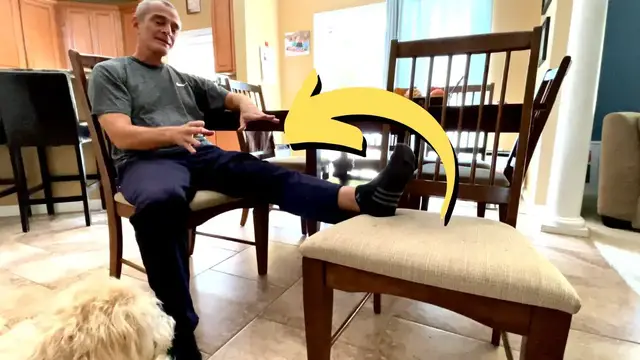
work on a heel prop is to sit in a typical kitchen chair, something that
0:39
allows me to have my feet comfortably on the floor. I'll pull a similar chair. Now
0:45
in the early stage, if I go straight to what you've probably seen before, which
0:51
is an unsupported heel prop, this is going to be usually too uncomfortable
0:56
for me in order to spend any kind of length of time here. So what I've found for my patients
1:03
is if we turn the chair sideways and we get the surgical leg up with a little bit of support under
1:10
the knee. Now I know that the surgeon and the physical therapist and everybody around you is
1:14
going to say we need to do it unsupported but what I want is I want to find kind of that sweet spot
1:21
So if I'm sitting back, the leg is up, even with a little bit of support under the knee, but I can tolerate this position
1:29
And then what I would do is I would slide the chair out to the point where my heel is on the seat
1:37
But now my knee is unsupported. I've got probably 90% of my calf muscle supported by the seat
1:45
That is going to be more tolerable to you. You going to be able to be in this position longer and it gonna be more effective As you improve you can shift the chair out further So maybe within the first 24 hours after surgery you got it pulled in really close
2:04
Maybe the second and third day, we've got it a couple inches down below the knee
2:09
By the end of the first week, maybe you have it all the way at the heel
2:14
Something that's interesting that I always try to explain to my patients is, because so many of my patients have some tightness through the hip, the toe and the leg wants to roll
2:24
to the outside. So what I try to encourage is a vertical foot as much as possible. If you have
2:31
your chair set up something like this, you can even kind of rest the side of your leg against
2:37
the chair. Even when it's in here, I can use the side of the chair to support the leg in this
2:43
kind of toe up straight position because when the surgeon puts the surgical knee in it is perfectly
2:49
straight so it would be a shame to spend a lot of time with that toe out stressing the lateral
2:56
compartment of the knee if you don't have to. So heel props this is one of my favorite and then of
3:03
course once you get full extension if you feel like you need just a little bit more you can always
3:08
bring the other leg either on top in this straight leg position or if you have the hip mobility you
3:15
can bend the knee and bring it above so here's my kneecap right here my shin on the non-surgical
3:22
knee is up above the pressure or even the incision of the surgical leg and i might just hang out like
3:29
this for a little while this is a really effective strategy for anyone who's had an acl reconstruction
3:34
a total knee replacement, any real procedure that causes limited terminal knee extension, this is probably one of my favorite ways to get it back. So guys I
3:45
hope that was helpful. If you have more questions post them in the comments below