Up next in 10

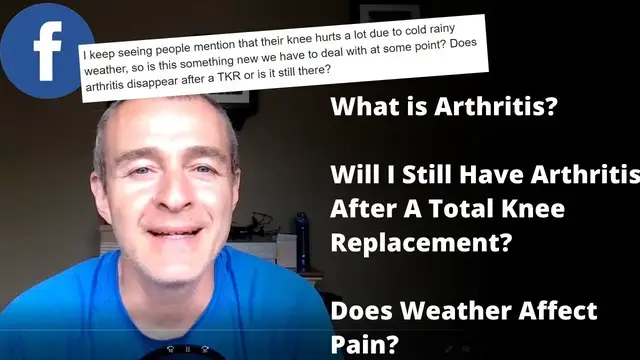
Knee Arthritis, "Will I Still Have Arthritis After A Total Knee Replacement" #DIYkneePT
Oct 29, 2022


Arthritis is removed during the knee replacement but that doesn't mean there aren't still structures that could cause pain. There is still connective tissue which may become inflamed and painful. There is still cartilage around the fibular head that may contribute to pain.
Recommended Amazon Products:
Best Cold Gel Pack: https://amzn.to/3eM3Ojl
Calf Stretch Wedges: https://amzn.to/2XSuWX0
Frozen Massage Roller: https://amzn.to/3csN6nw
Seated Pedal Bike: https://amzn.to/3dNLqG3
PCP Pedal Exercise Bike: https://amzn.to/2ZOHzVl
Please join our FREE Facebook group: https://www.facebook.com/groups/totalkneereplacements/
To Schedule A Call: https://tinyurl.com/y2l9x439
Total Therapy Solutions
5900 Long Meadow Dr
Middletown, OH 45005
Show More Show Less View Video Transcript
0:00
Hey, what's going on my knee warriors? Tony Maritato here. So once again, you guys force us
0:08
to be better clinicians. Karen posted this great question in the group and I thought it was worth
0:15
coming on, sharing my screen and sharing a little bit of knowledge. So I'm actually going to share
0:21
my computer screen. Hopefully nothing weird pops up. So Karen says, I keep seeing mention, let me
0:29
see if I can zoom in here for you guys. I keep seeing mention that their knee hurts a lot due
0:35
to cold rainy weather. So is it something new that we have to deal with at some point? Does
0:41
arthritis disappear after a total knee replacement or is it still there? I think probably the biggest
0:49
challenge here is the fact that what we are calling arthritis isn't a universal term my guess
0:59
is your understanding of the word arthritis is different than my understanding which is different
1:06
than the surgeon's understanding and even within that so you know still there been seven months
1:13
Doctor told me also Jacqueline had a great, great share that. Let me see if I can find it here
1:24
So like she took this from this bonesmart.org, arthritis being a degenerative disease
1:33
I'm going to I'm going to dispute that in just a minute. That destroys cartilage
1:39
So I would say osteoarthritis is a degenerative condition that destroys joint cartilage
1:48
Osteoarthritis is a condition that destroys joint cartilage. It is not resident in the bone
1:57
You see the rest, right? So let's just talk about language for a second
2:02
We know words have power. We know words can influence outcomes. you've heard the story you know if a person is raised in an environment where they're just
2:13
constantly badgered and told that they're going to amount to nothing and they're worthless and
2:19
they're terrible they tend to live up to that expectation and so within the medical community
2:26
I think most of the people in this group have probably been familiar with the term placebo
2:31
but nocebo is a term less used and nocebo essentially refers to language or interventions
2:41
that actually increase a negative outcome. So if I tell you, your knee is so bad, it is bone on bone
2:52
We would call that in the profession nocebo language that plants the picture in your head
2:58
of bone on bone, which must be painful. I mean, I don't know, you know, what does bone on bone
3:06
even feel like? If you really think and examine, we have no perspective. Even me as a physical
3:12
therapist, I cannot tell you what living bone on living bone feels like because I've never felt it
3:19
But certainly the perception is it must feel horrible. But what does that even mean? These
3:25
these are terminologies that are being thrown around by surgeons and by physical therapists
3:30
and other healthcare providers because it doesn't really mean anything to the provider
3:36
but it massively impactful on the patient and we making a concerted effort to stop using this kind of language And if you hear a provider a healthcare provider
3:48
say something that kind of fosters a sense of fear in you
3:54
I think you should bring it up. I think you should say something about it, and you should ask for more details
4:01
So I like this article. I've referenced this article in multiple public talks
4:05
Arthritis is very common, but it's not well understood. This is from the Arthritis Foundation
4:12
So it's a well-respected, reputable source. Actually, arthritis, the term arthritis, it's not a single disease
4:22
It's an informal way of referring to joint pain and joint disease
4:28
Because there are diseases. There's rheumatoid arthritis, which is an autoimmune disease
4:33
There's other things. arthritis, like here, there are more than 100 different types of arthritis and related conditions
4:42
So when somebody tells you, you have arthritis, they're basically saying, you know what
4:50
you have a stiff and painful joint. And maybe you have something some degenerative changes that are
4:55
going on there, or other stuff. That's it. Don't read between the lines, don't take more out of it
5:02
If they want to give you a definitive diagnosis, a real diagnosis, then let them do it
5:08
But a diagnosis of arthritis, you have arthritis in that joint or you will get arthritis in
5:14
the future. That is just like saying, well, you're going to have joint pain at some point
5:20
I've got joint pain, you know, like everybody has joint pain. That's a normal part of life
5:25
So just it's not a disease. I want you to understand that there are diseases within the umbrella of arthritis
5:33
But most of the clients, certainly, I know you guys are going to watch it, there are some of you who have osteoarthritis and rheumatoid arthritis
5:42
Rheumatoid arthritis is a completely different animal than osteoarthritis. If I fall playing with my kids outside and I damage my cartilage a little bit, there's a degenerative change that has happened to that cartilage
5:58
You know, so that's a normal function of life. Now, certainly there are pro-inflammatory conditions like type 2 diabetes and cardiovascular disease
6:08
And these conditions raise inflammatory markers that can be measured within the blood
6:13
and we tend to believe that the more systemic inflammation your body has, which it's like a
6:22
fever, right? It's your body's immune system fighting something. We don't know what. Then
6:28
there is reason to believe that that immune response may be a component in what's causing
6:36
the damage within the joint. Now there's some schools of thought that, well, I'm not going to
6:41
get into any more than I've already said. But the idea is I just want you to know, arthritis is not
6:48
a disease. Arthritis is an umbrella term, covers over 100 different kinds of conditions. And you
6:56
just need to be educated to know, okay, so I've got stiff joints and some pain. I knew that before
7:01
I went to the doctor, right? So let's get into the question about weather. And when somebody's
7:07
asking questions If you not familiar with this pubmed is a great resource Yes it super clinical and it above my head most of the time but it gives you some general peer you know the best chance you have at clinical
7:27
information that's not going to be selling you a product, that's not going to be somebody's opinion
7:32
Certainly there are biases in here like everything. So here's an article I found, the influence of weather conditions on joint pain in older
7:40
people with osteoarthritis. There's also articles about rheumatoid arthritis, which is a different condition
7:50
And so, you know, the study examines three-day average weather conditions and changes in
7:57
weather conditions influence joint pain in older people with osteoarthritis in six European countries
8:03
There was about 810 participants. So it's not a, you know, 100,000 participant study
8:10
Take it at face value. you don't put too much stock in it but it gives you a suggestion it says the association between
8:18
pain and daily average weather conditions suggests that a causal relationship exists
8:25
between joint pain and weather variables so association does not always equal causation
8:33
right now outside it's cloudy right every time it rains it's cloudy but every time it's cloudy
8:41
it doesn't always rain. So I can't create that kind of causation every single time. Just because
8:49
it's cloudy doesn't mean it's going to rain. Just because the weather changes doesn't mean you're
8:55
going to have joint pain. The data suggests that maybe there is a causal relationship between
9:02
weather changes and joint pain. But the associations between day-to-day changes, so yes for three-day
9:09
but single day does not confirm causation. Knowledge about the relationship between joint
9:16
pain and OA, osteoarthritis, and weather may help individuals with osteoarthritis. Physicians and
9:23
therapists do a better job understanding and managing fluctuations in pain. And here's the
9:30
big problem. So to answer the question Karen posted, Karen, I think if you asked the surgeon
9:36
he would say there's no arthritis left in that joint. We cut away all the arthritis. They would
9:42
basically say they cut away all the damaged parts of the joint and replaced it with a prosthetic
9:49
implant. So technically there is no arthritic damage within the joint. That being said
9:58
what does your knee, what is your knee made of? Your knee is not strictly made of bone and
10:03
cartilage. There's ligaments, there's soft tissue like muscles, there's veins and arteries and
10:10
lymphatic vessels, there's fascia, which is a connective tissue. There are many, many, many
10:15
more components to your knee than just the hardware that was installed. So I would say yes
10:23
a person can still have pain associated with the joint that was replaced. You know better than
10:31
anyone, your knee can still hurt even after your knee replacement as evidenced by the length of
10:37
rehab and the frustration that everybody with a knee replacement goes through. So that being said
10:44
the other component and the example that I always share is if you've ever had a cold
10:49
a flu a virus right You know that you getting sick because you feel that soreness that muscle ache that back pain It feels very orthopedic in nature But when you go 24 hours into it you like Oh I got a fever I got a runny nose you know
11:10
sore throat, I'm sick. But the orthopedic pain you were feeling in your muscles, that achiness
11:16
that malaise, that throbbing, if you didn't realize you had a cold, you would think and it
11:24
could easily be misinterpreted as osteoarthritis. The difference is it gets better 24, 48, 72 hours
11:33
later. But I just want you to understand that there are lots of things that will produce
11:38
the sensation of pain. It's not just the arthritis, the degenerative change that's
11:45
happened inside the joint. It's not just a single variable most of the time. A lot of times it's a
11:51
combination. It's, you know, poor sleep, poor nutrition, increased stretch, stress, weather
11:57
changes, history of trauma to the tissue. I've got a left knee that I just beat up over the years
12:04
doing lots of crazy stuff. Most of the time, it feels just fine. But on occasion, once a year
12:10
it wants to remind me, hey, I'm still here. You know, you took advantage of me when you could
12:16
so is are you karen going to experience pain in the joint with changes in weather no probably not
12:25
people who have always experienced pain in joints with changes in weather probably will continue
12:31
it might just not be in the joint that was replaced but hopefully the take-home message
12:37
from this this rant is that arthritis is not a disease arthritis is not a life sentence of pain
12:45
arthritis is a generalized term that covers over a hundred different varieties and conditions
12:52
that you just want to translate in your mind when somebody says hey i've got arthritis you say hey
13:00
i've got a stiff joint and maybe some pain somewhere also you know high five we've been
13:06
active because i promise people who are inactive have just as much arthritis and joint damage as
13:13
those who were active. So maybe in the next session, we can talk about activity, you know
13:18
bust some old wives tales and some myths. No, running is not bad for your knees. No
13:25
exercise doesn't destroy your joints. Yes, when you have joint pain, one of the best options is
13:31
to exercise, to do it in a correct, you know, effective manner that doesn't make your pain
13:38
worse, but improves your body chemistry. All right, I'm going to end it. I hope that this was
13:43
helpful. I hope this cleared up some things because I'm the first one to say, when we talk
13:48
about healthcare providers who say stupid things, my hand is up. I say stupid things every day
13:55
And after I say it, almost as it's coming out of my mouth, I'm like, oh, why did I just say that
14:01
to this person? Now this person is going to carry in their mind the image that I painted
14:08
which probably wasn't the right image, you know, because to me, it's like, yeah, who cares
14:13
Everybody has arthritis. I have arthritis in probably every joint of my body. It doesn't
14:17
mean anything. But to the person sitting in front of me, who's already scared, already in pain
14:23
already nervous about their future, you know, to them, I just like gave them a death sentence. I
14:31
mean, it's, it's really a shame the words we use and the ignorance on the healthcare providers part
14:36
So keep us honest. Keep the questions coming. I'll catch you guys in the next video. Best wishes
#Health
#Health Conditions
#Arthritis
#Pain Management
#Physical Therapy
#Jobs & Education
#Injury