0:00
Good morning guys, Tony Maritatto here, licensed physical therapist, and I want to talk to you today about two laying down self-mobilization exercises to work on both knee extension and knee flexion
0:12
Now I've got a couple other videos on the channel talking about these positions, but I haven't updated those videos for a while, so we're going to update those videos
0:20
So my favorite way for patients to work on knee flexion if they're at home
0:26
It's always kind of hard to explain the bed setup, but just imagine for a second if I'm sitting sideways at the edge of my bed, right
0:35
So the head of the bed is there. The footrest is down there. I'm sitting my feet are on the floor
0:41
If you have a taller bed, that's okay. But basically what we're going to do is you're going to have the surgical leg hanging off the side of the bed
0:49
you're going to scoot forward a little bit so there's some space between the side of the bed
0:54
and the calf muscle and then you're going to lay down and so as I lay down effectively what's
1:01
happening is I'm extending the hip while the knee is being flexed if you have a slightly higher bed
1:09
in fact I going to grab some pillows if you have a higher bed it even better but if you If you have a low bed that okay You put a couple pillows underneath the thigh and then what you gonna do
1:23
is again you're gonna lay back and you're just gonna let that leg rest in
1:29
this flexed position. Now I've got the pillow touching the calf muscles so I'm
1:34
getting a little bit of support. I can do a little bit of this kind of bouncing
1:38
motion and you can imagine how every time it comes down I'm trying to relax
1:43
the quadricep muscle I'm trying to let everything go loose a little bit of
1:48
discomfort is okay but once you get to the point where there's a sharp or really
1:52
noticeable pain you're not getting any more benefit on flexion the way to
1:58
improve flexion is to be able to relax in the flexed position if your bed is
2:05
high enough you can just remove those pillows and let the leg hang or dangle
2:10
down completely as you improve you might be able to tap your heel against the
2:16
side of the bed if this becomes too easy you can always slide forward a little
2:21
bit more and go get a little more knee flexion in there of course we could use
2:26
the non leg crossover in front to get it if it becomes too uncomfortable I can use the non leg behind my knee to kind of help support it and lift it But the idea is that I
2:40
find that patients who have a target, who have something that they can feel with their heel
2:48
tend to do better when they're working on knee flexion. Now we're going to flip over and we're
2:53
to talk about knee extension for a minute. So let's pretend your flexion is coming along and you want
2:59
to work on that last little bit of three to five degrees of extension. There's two positions that I
3:05
like best both of them laying on your stomach. Now if you have low back issues, if you have spinal
3:11
stenosis or any kind of arthritis in the low back, this is not the right exercise for you and that's
3:17
totally fine. There's lots of other exercises you can do but if you don't mind laying on your stomach
3:23
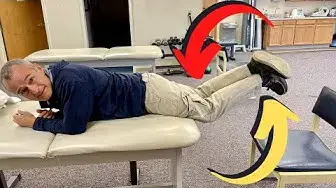
Then one of the best ways to do it, these are called prone hangs
3:28
is I literally lay on my stomach. I put my kneecap off of the edge of the bed
3:33
So this is the side of the bed. My kneecap is not touching the bed at all
3:38
And I just relax in this position. I let gravity do the work. I could do a couple bounces again as long as I don feel any sharp pain A little bit of discomfort is acceptable Pain is not And I might spend three to five minutes in this position I could hook my non leg
3:56
under my surgical leg to give me a little support if I need a break. I can hook my non-surgical leg
4:03
on top if I feel like I need a little bit of extra pressure to increase the extension while I'm in
4:11
this position. If this is too uncomfortable, you can come up a little bit higher so there's a little
4:18
bit of support, but I will say that if the knee is on the bed, there's going to be some pressure on
4:23
the incision. Now, if your incision is sensitive, there are other videos on the channel talking
4:29
about desensitizing a sensitive incision. So guys, these are just two recommendations. It is
4:35
like an endless list of exercises that can be done to improve flexion improve extension these
4:42
are the kinds of things that i want you to talk to your physical therapist about because your
4:47
physical therapist is amazing at coming up with alternative ideas new things really new things
4:53
to do the same thing new ways to do the same thing which is improve flexion improve extension
4:58
guys thanks so much for supporting the channel please subscribe if you haven't and i'll catch
5:02
you on the next video