Up next in 10

3 Tips To Walk 🚶♂️ Normally 🕺 After A Total Knee Replacement
Oct 29, 2022


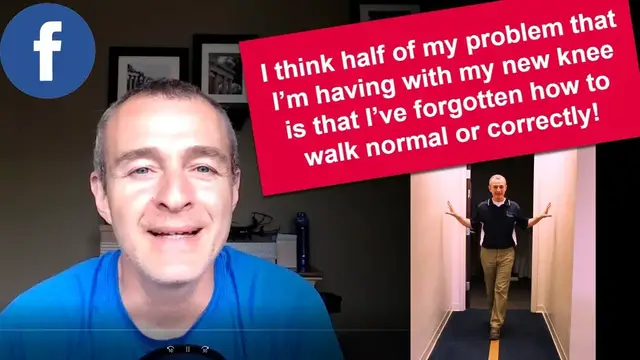
Walking normally after a total knee replacement is always a challenge. Improving knee extension, relaxing the muscles of the hip, knee, and ankle, and improving leg swing can play a major role in normalized walking. Practice in a safe and pain-free range of motion to optimize your ability to walk normally again after knee surgery.
00:00 Introduction
00:49 Practice in a hallway
01:05 First measure stride length
01:30 Stop the chop, short choppy steps
01:45 First exercise, weight shift forward and back
02:21 Weight shift sideways in hall
03:00 Second exercise, improve swing
04:48 Third exercise, balance beam
07:15 Heel raises in stride
07:50 Side step with heels up
Find us online at: https://www.totaltherapysolutions.com
Find us on Facebook at: https://www.facebook.com/ttspt/
#tkr #kneesurgery #physicaltherapy
Show More Show Less View Video Transcript
0:00
Hey everyone, Tony Maritatto here, physical therapist
0:04
So one of the most common questions we get asked in physical therapy following a total
0:09
knee replacement is, when can I start walking normally again? When is this limp going to go away
0:16
How am I going to walk normally? And so it's a challenging question because there really isn't an answer
0:22
It depends. It depends on how long you walked with the limp prior
0:26
It depends on what the ankle and the hip are doing, not just the knee
0:31
And it depends on how quickly the healing process happens for you
0:36
Everybody heals at a different pace. But I'm going to show you three of my favorite ways to improve the mechanics of walking as close to normal as possible
0:47
So let's take a look. If you notice, I'm in a hallway. I'm in a hallway because it gives me kind of easy access to both walls
0:54
So I'm going to go ahead and back up, excuse the cable, so you can see that I've got the
0:59
hallway here, both walls. And one of the first things that we do, I'll see if I can zoom in on the camera, is I take
1:07
a look at what we call the stride length, how far the front heel is from the back toe
1:15
And typically, if I've had a knee replacement, let's say in this case on my right side, what
1:21
happen is I don't have full extension in that right knee and I don't necessarily
1:26
let my left foot go far in front so I tend to take this kind of short choppy
1:33
step totally fine totally normal in the beginning but what we want to do is we
1:39
want to lengthen that stride so sometimes what I can do is put my hands
1:43
on the wall I step my non-surgical foot toward the wall and then I just shift
1:51
forward and I shift back I shift forward I shift back I'm doing this about five
1:58
or six times getting comfortable with it and then I switch I put my surgical
2:03
foot forward I let my heel touch I roll to the flat part of my foot and then I roll back to my heel and so again I do this five or six times working back and forth and just trying to get as comfortable with this front to
2:20
back motion as I can. I can do it in the hallway sideways or as I would normally be walking down
2:28
the hall so I put my surgical foot in front my heel touches I come over that foot and I come back
2:35
I come over that foot and I'm just getting kind of the confidence to know what that leg is going to handle
2:44
And then of course I switch and I put my non-surgical foot in front
2:49
And what I'm doing on my back side, my surgical side, is I'm allowing that to go from heel down, rolling off the toe
2:57
So that's part one. It's just widening the stride length so that I'm comfortable knowing I can take
3:07
a step and I'm not going to lose my balance side to side. The second part is the swing phase and
3:15
that's usually what people are kind of the most concerned about. What happens is when that knee
3:20
is swollen a little bit painful, it's kind of locked in that bent position. We treat it like
3:26
a peg leg like a stick that doesn't have a joint in the middle and so what happens is people tend
3:32
to walk and they don't let it bend or extend so how do we work on that practice desensitization
3:39
i just kind of stand leaning against the wall i let that leg swing through kind of like a pendulum
3:48
i could do it this way as well and i just when the leg is back the knee is bent when the leg
3:56
is forward, the knee is straight, and I just try to get 10 to 15 of these little swings
4:03
You can think of it like kicking a ball. You can think of it like a pendulum. The more comfortable
4:09
you get, the smoother it gets. And then, of course, just like everything, we do the other side
4:16
And so why do we do the other side Two reasons One is I want to feel what the non leg does I want to feel how it swings what it feels like to remind my brain what the surgical side
4:32
should feel like. The other reason why I do the non-surgical side is because it
4:37
makes my surgical side absorb the weight of my body and get comfortable holding
4:44
myself up, loading the other leg. Finally, tip number three. Now you can certainly use a line
4:52
in the ground like if you have linoleum or tile. I personally prefer, I'm going to say this is a
5:00
one by four. And so it's not a two by four. It's not a tall piece of wood. It's a very like half
5:07
inch, maybe even a quarter inch is fine. You just want something that lets you feel the edges in the
5:13
side. I place it again in my hallway so I have walls on either side to kind of control that
5:20
lateral stability. I set up. Now, your heel does not have to touch your toe. You can create a little
5:28
space between the heel and the toe, but the idea is now I'm on this kind of narrow base of support
5:35
stretching my stride length out. And so I take a step. I stop. I hold that position. My hands are
5:43
on the wall as much as need be, but as I get more comfortable, I can start to break that contact a
5:48
little bit. Every time I step, I stop. I feel my body and my balance and kind of building that
5:56
sensitivity, and I make sure my feet are straight. A lot of times, we don't realize it, but when we
6:03
take a step, our foot is turned out. Occasionally, our foot will be turned in, but most often, the
6:10
foot is turned out. So this gives you a chance to exaggerate a straight foot placement, perfect
6:18
alignment. This way when you are walking normally again, you don't have to think about it, right
6:24
When you're training, when you're exercising, when you're working on improving the quality of your
6:29
movement we exaggerate perfection This way when we go out and do it in the community when we playing with our grandkids and our children we don think about it We just do it We want movement to be natural
6:41
It shouldn't be effortful, contrived. It should just come the way it comes
6:47
So I get on a board like this. I set up. I walk down
6:52
You can look at it initially. Eventually, you'll look up. And then I step off
6:56
I turn around. And I do the same thing going backward. I step and stop, step and stop, each time holding that position
7:05
Bonus content. If you're looking for something that you want to do that's maybe a little outside the usual
7:11
I love to get in this stride position with my patients and then have them do their heel raises
7:17
where they come up on their toe, two sets of 10, right on the balance beam
7:23
It's one thing to do heel raises here where you're standing and your hands are on the counter
7:29
or you're at a wall. But this isn't really functional. You don't just stand in public doing this
7:36
You do a heel raise when you're walking to propel yourself forward
7:42
And so by doing it on the balance beam, it kind of takes it one step closer to function
7:48
The other bonus content, my personal favorite, is that I'll have my clients set up
7:53
where their heels are up from the ground. They don't have to be super tall, but I don't want them touching
7:59
And then they simply sidestep. They're sure not to drag the foot
8:05
They pick up the foot. They come down to the end, and they sidestep back
8:10
Their hands are on the wall the entire time. If they start to get really advanced, they can start to come off the wall
8:15
But the idea is that you want that kind of control so that you know when you're walking
8:23
when you're moving, when you're doing things, it comes naturally, effortlessly. and enjoyably. You got a knee replacement to enjoy life. Let's get you back to enjoying life
8:39
Once again, I'm Tony Maritato. If you have any questions, please post them in the comments
8:43
Otherwise, thank you for watching this video
#Health
#Physical Therapy